Stamping of a steel bowl
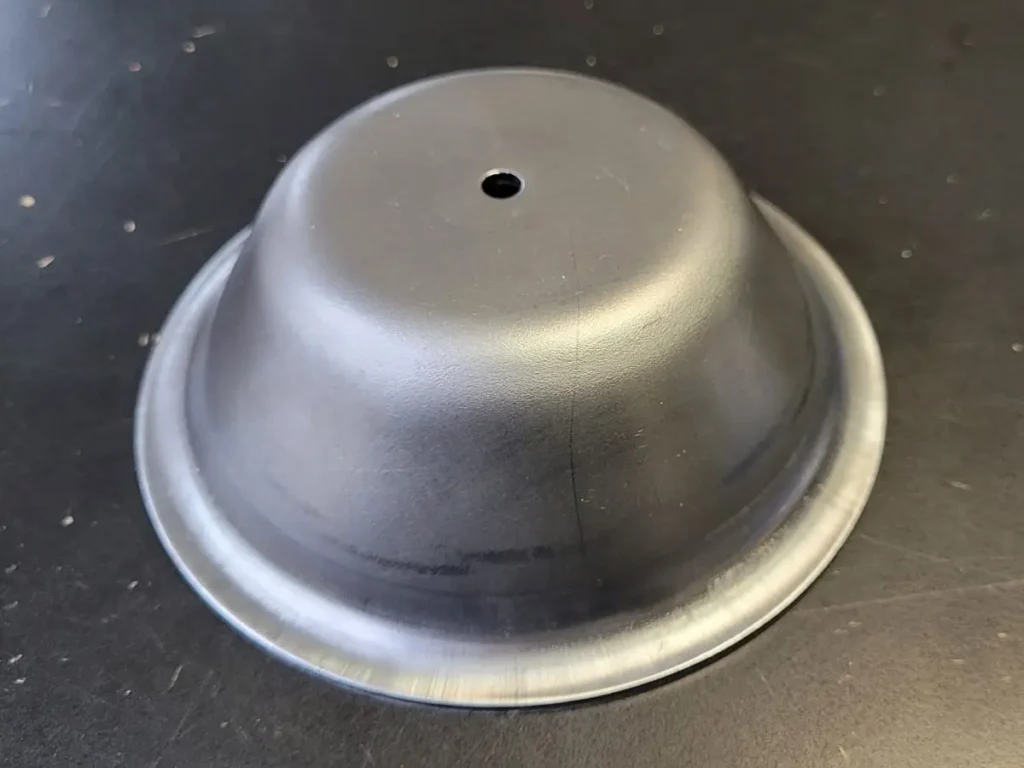
We have recently developed for a new client tooling for producing stamped bowls from pickled steel.
To achieve this, we started with the client’s functional requirements to propose a stamped part geometry that met their expectations.
Indeed, given the limited volume of stamping requirements, we had to jointly define a shape that could be formed in a single strike on a mechanical press.
Steel Selection for Stamping
The specifications required steel suitable for welding and hot-dip galvanizing. For this, we selected a Class 1 galvanizing-grade steel, which provides excellent appearance and very good coating adhesion, with the most homogeneous hot-dip galvanized coating. With a Silicon content less than or equal to 0.030 and a Silicon +2.5 Lead value less than or equal to 0.090, we will achieve the best results in terms of protection, appearance, and compliance with standard NF EN ISO 1461.
Considering the steel characteristics for the intended application and the target price, we applied all our stamping expertise to produce the part from a steel that is not necessarily the easiest to stamp.
Indeed, we chose to use standard steels such as DD11 or, according to EN 10027-2, designation 1.0332. This 3 mm thick steel has an A80% elongation of 28 mm, a Yield Strength (Re) of 170 to 360 N/mm², and a maximum Tensile Strength (Rm) of 440 N/mm².
Other, much more expensive steels would have been much simpler to stamp with higher elongations, such as DD13 or DD14, which have elongation coefficients of 33 and 36 respectively for a 3 mm sheet. Nevertheless, at Kuchly, we always strive to optimize to reduce costs and delivery times for the client.
Operation of the Stamping Tool
The difficulty with a stamping tool is to form the part without generating folds in the sheet metal, which would be linked to a high concentration of stress in certain areas of the metal part.
To prevent this phenomenon, we equipped the tool with a blank holder and installed powerful springs to achieve a clamping force of approximately 6 tons, considering the thickness of the sheet metal to be stamped. The blank holder allows, as the deformation progresses, to control the sliding of the sheet metal until it reaches the die bottom, which will mark the various folds. Within the tool, we integrated two circular knives to trim the part once the press’s bottom dead center is reached.
The entire design and production of these parts are carried out within our tooling department at Kuchly.
Hardening of Stamping Elements
For stamping tools and press tools for industry, we frequently use Z160 steel or NF EN 10027-1/11-92: X 160 Cr Mo V 12. Its chemical composition includes an average of 12% Chromium, 1.55% Carbon (C), 11.8% Chromium (Cr), 0.75% Molybdenum (Mo), and 0.9% Vanadium (V).
In our pursuit of high toughness (hardness approx. 53/56 HRC), we perform slow heating (with homogenization at 750°C) for austenitization at 1030/1040°C to transition from a body-centered cubic crystal structure to a face-centered cubic crystal structure with the thermal shock obtained by immersing the part in oil. To improve brittleness, we perform two tempering treatments at temperatures near 520°C – 540°C.
After hardening all the parts, they are sandblasted to clean them and allow for the sharpening and adjustment of the stamped parts.