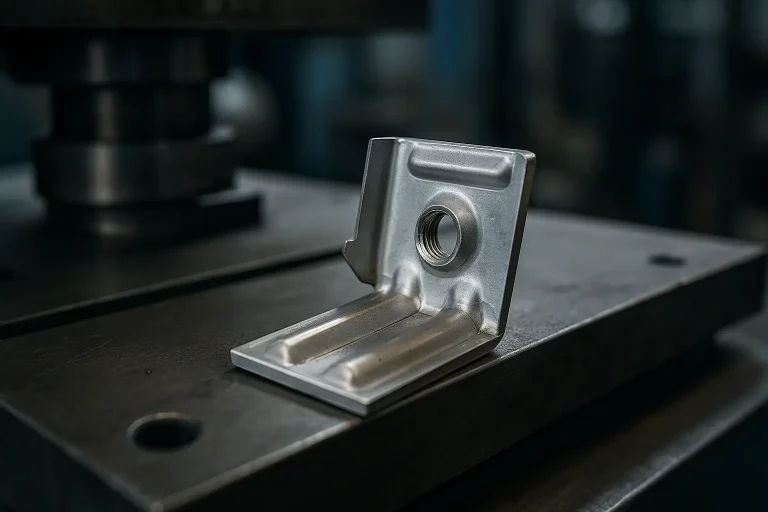
There are four stamping techniques for forming metal parts: stamping with single-action, double-action, hot/cold, and multi-pass tools. This article will help you better understand how these stamping techniques work.
Stamping is a manufacturing process used in industry to shape or cut metal by deforming it with a die positioned on a machine tool, commonly known as a stamping press. The stamping process involves forming metal between two halves of the press tool. Depending on the mechanical characteristics of the part to be formed, the initial metal thickness, and the shape of the finished product, one of these stamping techniques will be chosen.
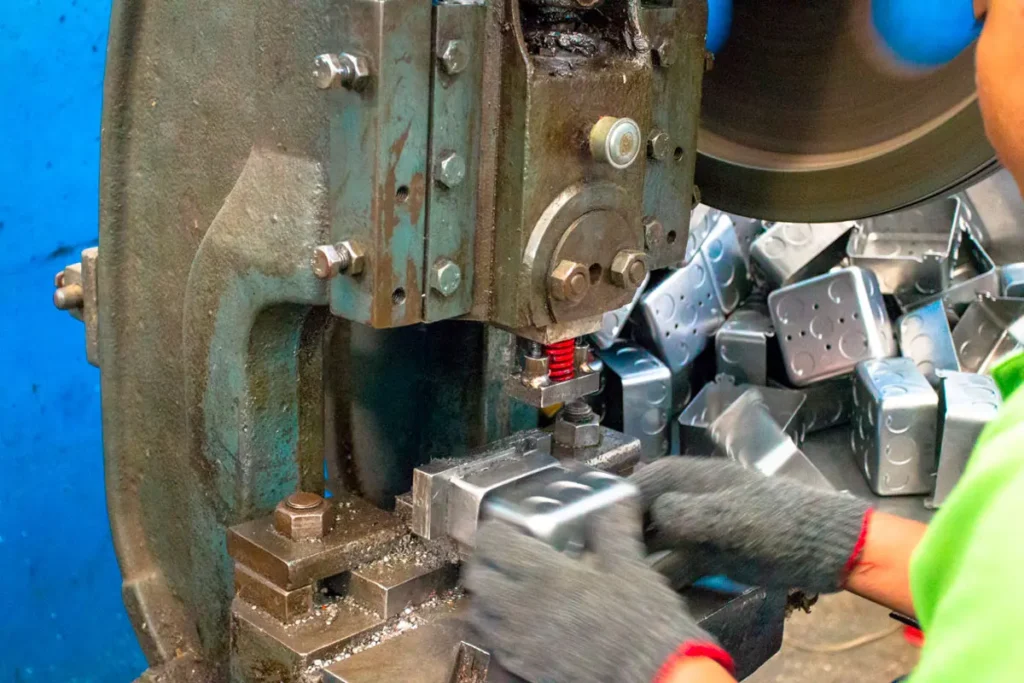
1. Stamping with single-action tools
As its name suggests, stamping with single-action tools is the simplest of the four processes. Here, the tooling used consists of a die and a punch. The former is clamped to the fixed table, the latter to the slide, which moves with a reciprocating linear motion. This technique produces shallow stamped parts and does not require significant clamping force. In the single-action tool method, stamping can be performed cold or hot, and on some presses, the die can move.
2. Stamping with double-action tools
The double-action tool technique follows the same principle as single-action stamping, but with the addition of an extra tool. Indeed, the double-action process includes a blank holder. The blank holder’s role is to hold the blank during a stamping operation. More precisely, this tool ensures the metal flows to prevent wrinkling of the part due to a drawing effect. The blank holder applies clamping pressure to the faces of the metal sheet (blank). Initially raised with the punch, the blank holder descends and applies a specific pressure to hold the sheet metal while allowing it to flow. Then, the punch descends in turn and plastically deforms the metal by pressing it against the bottom of the die. The double-action tool technique produces deeper stamped parts but requires greater clamping forces.
3. Cold stamping (and hot stamping)
Cold stamping is the most widespread technique. The materials involved in this type of stamping are mild and stainless steel, aluminum, copper, and brass. This stamping technique is frequently found in the automotive industry because it allows for:
- more stable dimensional accuracy;
- low production cost;
- good mechanical properties of stamped parts.
However, this stamping technique has some disadvantages:
- high rate of material strain hardening leading to a significant risk of structural hardening and a decrease in material ductility. Recall that the ductility of a material defines its ability to be easily deformed or stretched.
- significant residual stresses, such as the risk of fatigue failure.
In summary, damage is the main limiting factor of the cold stamping technique. On the other hand, hot stamping is used on single or double-action hydraulic presses. The heat ranges from 200 to 500 °C. The materials used in hot stamping are titanium, magnesium, and zinc. This stamping technique offers numerous advantages:
- effective on steels and aluminum, as deformation is easier on less ductile materials;
- possibility of stamping thick and deep parts by heating the blank and the die;
- little strain hardening or residual stresses.
Nevertheless, hot stamping has some disadvantages:
- heating inertia due to lower production rates;
- finished parts of lower quality due to surface finish and then dimensioning;
- the implementation of a stronger safety protocol.
4. Multi-pass stamping:
Multi-pass stamping, also known as progressive deep stamping, transforms thick blanks in several passes to prevent mechanical failure during the deformation process. The depth of the stamped parts is significantly greater than all other previous techniques. The multi-pass process is often necessary to achieve a better deformation path and thus avoid necking and wrinkling. One of the major advantages of multi-pass stamping is high-volume production.
Furthermore, this technique allows for the production of highly deformed parts within the same progressive die without increasing cycle time or requiring additional labor.
It is a method suitable for high-volume production. The thickness of stamped parts can be very small (around 0.05 mm).