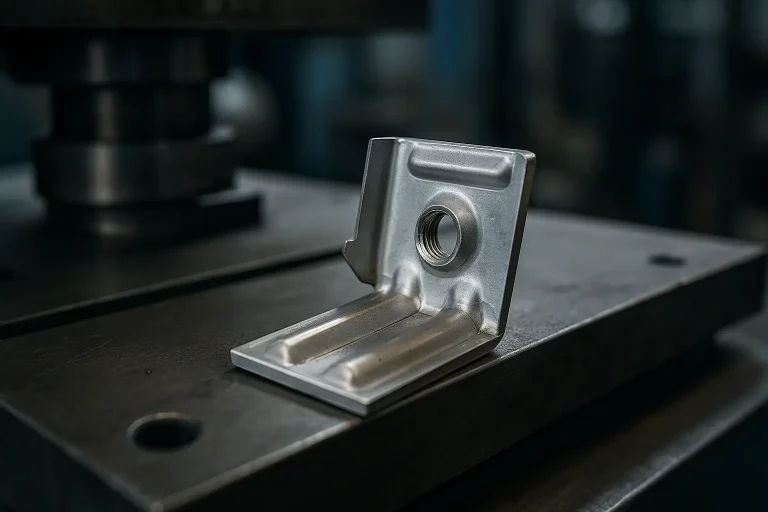
The main causes of defects in stamping that can occur during metal part stamping operations are related to tool parameters and their lubrication, as well as the properties of the materials used.
This article will help you control your tooling and materials to better prevent potential non-conformities in your parts formed by stamping processes.
To avoid serious defects such as wrinkles, warping, fracture, necking, and deformation, it is possible to anticipate them by directly addressing these three common causes of non-conformities encountered when using stamping techniques.
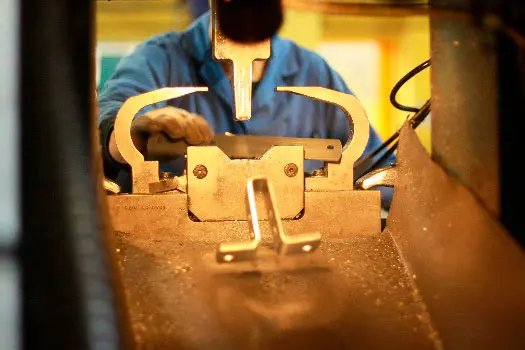
Tool parameters as a cause of defect in stamping
The parameters of the blank holder, punch, and die are among the most probable causes of wrinkle formation in stamping.
The geometry (or positioning) of a stamping press’s blank holder, as well as its pressure, plays a crucial role in the successful production of the parts to be formed. A common defect, wrinkles are undesirable undulations formed on the flange or edges of a stamped part. To prevent the part from wrinkling due to a shrinking effect, the blank holder exerts clamping pressure on the faces of the metal sheet (blank). However, if the blank holder pressure is too strong, wrinkles can also appear. To prevent them, the blank holder force exerted during the punch stroke must respect the metal’s deformation capabilities.
In summary, the blank holder parameters must be reviewed upon observing wrinkles on the parts. Furthermore, tearing is another defect characterized by the presence of small cracks on the stamped part. When the die edge radius is inadequate, as well as the clearance between the punch and the die, a tearing effect can occur on the metal.
Even if it may seem obvious, it is useful to remember that the more complex a stamping tool is, the greater the possibilities for errors, due to the delicate parameters mentioned previously, where non-conformities can arise.
Tool lubrication as a source of defect in stamping
Lubrication aims to reduce tool wear. It allows the material to slide easily and uniformly between the blank holder and the die during stamping. Typical lubricants are mineral oils, notably composed of lard oil. The viscosity and quantity of lard oil are essential parameters to consider.
Tool lubrication in stamping is a way to prevent scratch-type defects. Indeed, if the process lubrication is not adequate (in nature or quantity), a friction effect can appear, leading to surface scratches on the parts. Also, galling effects and accelerated tool wear (or fatigue) can occur. Furthermore, surface scratches manifest when the punch and die surfaces are rough.
Properties of materials to be formed as sources of defect in stamping
The properties of materials can have an impact on the quality of stamped parts.
The metallic steels used in stamping are: iron, steels, and cast iron.
The carbon grade – more or less mild, ranging from <0.05% to 5% – induces critical mechanical qualities for part formability such as elasticity, ductility, and anisotropy.
Other mechanical qualities of steels can be influenced by the addition of other metals such as manganese (to increase elasticity), nickel (increases impact resistance), or vanadium (to increase wear and deformation resistance).
The elasticity of materials in stamping
For example, common steels allow for improving the compromise between formability and strength. With these types of metal, complex shapes can be achieved. However, the more resistant a material is, the more likely the elastic springback phenomenon is to occur. It is therefore important to know the metal’s Yield Strength (Re).
Conversely, as seen previously, tearing is a defect characterized by the presence of small cracks on the stamped part; this is also related to the elasticity of the metal used.
The ductility of materials to be stamped
The ductility of a material defines its ability to be easily deformed or stretched; that is, capable of undergoing irreversible deformation. For this quality, the malleability of the material to be stamped is measured.
It should be noted that damage is the main factor limiting ductility in bulk products.
The anisotropy of materials to be stamped
The anisotropy of a part represents properties varying according to direction; which can exhibit different characteristics depending on its orientation.
Depending on the metal’s anisotropy, ears can form on the upper edge of the stamped part. It is therefore necessary to check the pattern orientation and rolling direction to determine the anisotropy.