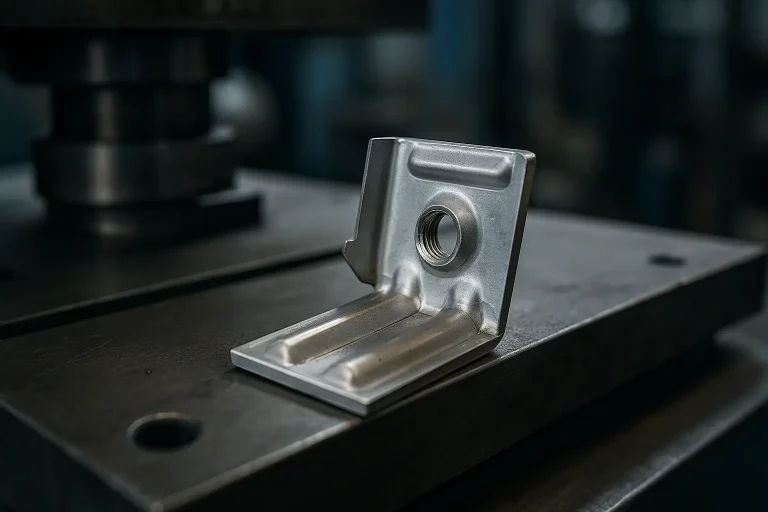
Aluminum stamping is found in various industrial sectors, ranging from more or less complex ones such as aeronautics, through food and automotive, to IT and mechanics, and even everyday consumer goods.
In this article, you will discover the application areas of aluminum stamping where it is used, as well as the finished products obtained through this process and the advantages of this metal.

Why is aluminum so well suited for stamping operations?
Aluminum is perfectly suited for stamping operations due to its strength and workability. Indeed, this material is valued for its fatigue resistance, lightness, and anti-corrosive properties. Its characteristics vary depending on the alloys.
We will not discuss them here, but let’s note the following constants. This metal is characterized by
Aluminum is also more ductile than steel, thus requiring less energy, smaller machines, and tooling to form the same part. It is therefore more economical to use this metal. Although its weldability is low, it is, conversely, an ideal candidate for stamping and is consequently sought after in many markets.
Industrial Sectors and Finished Products Made from Aluminum Stamping
Aluminum Stamping in Aeronautics
Since the beginning of the 20th century, aluminum has been the most widely used metal in aeronautics. Parts manufactured for this sector are characterized by tight tolerances and particular attention to weight. Indeed, the low density of this metal is of great interest in this field. Here are some examples of aluminum parts for aeronautics incorporating stamping: hydrogen protection casing, heat shield, pressure gauge covers, aeronautical pipe bending, hydraulic sealing, aircraft dashboard gauge bezels, ball joints, bearings, protective sheet metal, ventilation system, landing gear, etc.
Aluminum Stamping in the Automotive Industry
Beyond aluminum parts, stamping processes are generally in high demand. Manufacturers in the sheet metal cutting/stamping sector hold a significant position among suppliers of automotive parts and equipment, accounting for 47% of investments (source: Department of Industrial Studies and Statistics of the Ministry of Economy, Finance and Industry, 2004).
Indeed, stamping aligns well with market constraints, as the automotive industry is synonymous with high volume and low production cost. More specifically, aluminum part stamping is also valued for its ability to reduce the weight of vehicles that are increasingly equipped. This material offers a good strength-to-weight ratio for this market. In terms of production rates, this metal, depending on its mechanical properties, allows for rapid stamping speeds with rates ranging from 12 to 43 m/min (or 40 to 140 ft/min) on single/double-action punching presses.
However, steel remains particularly competitive in the sector compared to aluminum due to its lower cost. Examples of stamped automotive parts include: interior floor, roof, side panel, bumpers, etc.
Aluminum Stamping in the Food, Chemical, and Pharmaceutical Industries
The properties of this metal are suitable for food and other preparations. Indeed, as a remarkable barrier material, even at thicknesses of a few microns, it protects the products it packages from light, humidity, air, and microorganisms. It thus preserves the essential qualities of stamped products; particularly the organoleptic properties of food (hygiene, flavor, taste, smell, fragrance, and color). Parts manufactured by stamping in the food sector include
For the pharmaceutical sector, this allows for the transport or containment of raw materials, perfumery compositions, or chemical products (adhesives, dyes, paints, etc.). This includes, among other things, stamped parts such as cans or tanks. Finally, this metal is highly resistant to temperature variations, which facilitates, for example, its sterilization by dry heat or in an autoclave (stamped pressure equipment used for sterilization).
Aluminum Stamping in Other Sectors: Mechanics, IT, Everyday Objects, etc.
Aluminum stamping is also present in various industrial fields. As we cannot cover all of them, we provide some examples below.
Aluminum Stamping in Mechanics:
- Agricultural drive shaft covers
- Ball bearing flanges
- Diaphragms for gas valves
Aluminum Stamping in IT and Electrical Components:
- Long-life capacitor
- Connector covers
- Household appliances
Aluminum Stamping in Everyday Objects:
- Rectangular cans
- Sink
- Conical/cylindrical buckets
- Cooktop support